Here is a terrific little game perfect for St. Patrick's Day learning centres, taught to me by a the talented Occupational Therapist Denise Rice who regularly visited my classroom last year.
Here is how it works:
1. Each student playing needs a Leapin' Leprechaun page (as seen in the photo above).
2. Each student places 10 pennies on the green circles at the top of the page.
3. Taking turns, players roll the dice and remove the corresponding number of pennies from the green circles. As per Denise's instructions "students pick up the required number of pennies by “squirreling” them in their hand (for example, pick up the pennies with their thumb, index, and 3rd finger and at the same time (and with the same hand) hold the pennies they have already picked up with their 4th and 5th fingers against their palms). This also helps to develop proper pencil grasp, so the muscles of the hand learn a correct tripod grasp and the other fingers are curled into the palm of the hand which acts as a “stabilizer” while holding a pencil for drawing/printing. "
4. The game continues until all players pennies have been moved from the green circles to the pot of gold via "swooshing" them along the rainbow. Again, the motion of "swooshing" each penny from the base of the rainbow to the pot helps to develop fine-motor control as the child's index finger controls the movement of the penny.
5. Once everyone is finished, each child gets a chance to wave the magic wand (actually a magnet wand) over the pennies in the pot of gold. The magical part is that only certain pennies from certain years are magnetic depending on the metal composition of the coin... not that you have to explain that to your kindergarten students.
6. I often provide some addition practice to my students by challenging them to figure out how many magic pennies (magnetic pennies) there are all together.
If you would like a PDF file of the Leapin' Leprechaun page please drop me a line at mrcampbellsclassroom@shaw.ca and I'd be happy to share!
To all who come to this happy classroom... WELCOME! Here you enter a place of friendship, learning, and magic.
Search This Blog
Monday, March 12, 2012
Saturday, March 10, 2012
A Flurry of Fun
With the end of winter just around the corner in these parts, I thought it a good idea for my students to create snowpeople that would resist melting. After reading various stories about snowmen (Snowballs by Lois Ehlert, The Biggest, Best Snowman by Margery Cuyler, and Snowmen at Night by Caralyn Buehner) we set about to write a list of criteria for making the perfect snowman. We used empty coffee cream bottles and styrofoam balls as the base of our sculptures adding details such as googly eyes, buttons, fabric scraps, and feathers from a moulting boa I found lying around my house (don't ask!). Our Grade 4 Reading Buddies assisted the kindergarten children by helping with gluing and the insertion of appendages (we used popsicle sticks, pipe cleaners, and golf tees for arms).
We proudly displayed our finished masterpieces in the school office so that parents and guests can feast their eyes upon our "Flurry of Fun!"
| Notice that the snowman front and centre is sporting a pattern on his buttons. An incredible little math detail that the young artist included without being asked to. |
Wednesday, November 30, 2011
Curb Appeal
A hot property has just become available in Room 216! This charming gingerbread cottage features newly installed chocolate chip cookie shingles, peppermint stick trim, and lollipop landscaping. Run, run as fast as you can, it is a house fit for an aspiring gingerbread man.
For the past week the students in my room have been merrily working on decorating this giant cardboard house which was generously donated to us from Notables (Edmonton's fanciest card and gift shop located in the posh 124 Street area).
Don't let the beauty of it fool you... there has been some hard work and many curricular objectives met through the assembly of this "gingerbread" house. Multiple skills were used for the chocolate chip shingles alone: students had to trace around a circular stencil, cut the curved lines they drew, draw 7 chocolate chips on each cookie, and learned about light brown, medium brown, and dark brown. Notice the gumdrop trim on the rooftop. Each candy has been carefully cut out by nimble little fingers and then added to the structure in a pattern. Peppermint sticks were a particular challenge to many children demanding that they pay careful attention to stay in the lines and repeat red on every second segment of the candy cane. Who knew math and fine-motor development could be so sweet?
I am currently using the gingerbread house as a quiet place for two students to play with the Lite-Brite (another great fine-motor activity allowing fingers to push light pegs into corresponding holes). And the best part is that the decor can be removed and changed out to a new theme once the holidays are over.
| This is the house as it neared the completion of its most recent renovation. That giant green beanstalk to the right of the house is one of three we made after reading Jack and the Beanstalk. |
Don't let the beauty of it fool you... there has been some hard work and many curricular objectives met through the assembly of this "gingerbread" house. Multiple skills were used for the chocolate chip shingles alone: students had to trace around a circular stencil, cut the curved lines they drew, draw 7 chocolate chips on each cookie, and learned about light brown, medium brown, and dark brown. Notice the gumdrop trim on the rooftop. Each candy has been carefully cut out by nimble little fingers and then added to the structure in a pattern. Peppermint sticks were a particular challenge to many children demanding that they pay careful attention to stay in the lines and repeat red on every second segment of the candy cane. Who knew math and fine-motor development could be so sweet?
I am currently using the gingerbread house as a quiet place for two students to play with the Lite-Brite (another great fine-motor activity allowing fingers to push light pegs into corresponding holes). And the best part is that the decor can be removed and changed out to a new theme once the holidays are over.
Tuesday, November 29, 2011
A New Spin
After reading a number of traditional versions of Goldilocks and the Three Bears I came across this delightful version which takes the classic fairytale and gives it a new spin. Cindy Meyers' account of Goldilocks misadventures follows the basic traditional storyline but changes things up by having Baby Bear use a wheelchair to get around. As well, Baby Bear has a very comfy bed that has a remote control to make it go up and down. Of course, Goldilocks' innate curiousity gets the best of her as she discovers these unique items. The story also ends in a very different way sending a lovely message of inclusivity and cooperation.
As I introduced the book to the children in my class I asked them what they noticed about the picture on the front cover. Here are their responses:
"There is Goldilocks."
"I see flowers."
"There is a butterfly."
"They are outside."
"They look happy."
"Where is the Mama Bear and Papa Bear."
"They are outside in the woods."
I was surprised (and delighted) that no one seemed to notice anything unusual in the fact that Baby Bear was in a wheelchair.
Sometimes I think children should run the world.
As I introduced the book to the children in my class I asked them what they noticed about the picture on the front cover. Here are their responses:
"There is Goldilocks."
"I see flowers."
"There is a butterfly."
"They are outside."
"They look happy."
"Where is the Mama Bear and Papa Bear."
"They are outside in the woods."
I was surprised (and delighted) that no one seemed to notice anything unusual in the fact that Baby Bear was in a wheelchair.
Sometimes I think children should run the world.
Wednesday, November 9, 2011
Full of Beans!
Jack got more than he bargained for when he exchanged his beloved cow for a handful of magic beans. Imagine the excitement in my classroom when I tell my students that I have a whole bunch of magic beans that can be used to create a variety of colourful and interesting patterns as we build our names.
As the children create patterns on the letters in their names I encourage them to make each pattern different and challenge them to try their hands at "trickier" patterns (like double attributes or three different colours of beans). Upon completion of their name we count the letters, identify the letter their name begins with, and write a simple "story" about their name to be displayed with their project.
| This organizer is an excellent way to keep the beans sorted. I print each child's name on heavy cardstock paper. |
Tuesday, November 8, 2011
Kindergarten Kingdom
November can be a dreary month. The festive orange pumpkins and bright fall foliage of autumn have been put away. The tinsel and gingerbread are not yet ready to make their Christmas appearance. And so we arrive at a month that can be rather bleak. To combat this dilemma I have designated November as Fairy Tale month each year. What could be more magical than sprouting beanstalks, industrious pigs, and magic carpets?
Most Kindergarten classroom have a dress-up center in the form of a large playhouse. Often featuring plastic food, small dishes, an assortment of clothes to change into, and baby dolls to care for. It is a great place to practice the business of being an adult and running a household. But suppose you were destined for a greater calling... perhaps a position in a royal family. What is a little king, queen, or knight to do? Each November my house center magically transforms into a posh fairytale castle with a wardrobe bursting with crowns, capes, and scepters for those that choose to play there. And we are never too alarmed if a grouchy stomping giant shows up or a menacing witch planning to brew up a powerful potion swoops in!
Of course the design of the castle in my classroom was greatly influenced by Sleeping Beauty Castle at my favourite place on earth... Disneyland!
Most Kindergarten classroom have a dress-up center in the form of a large playhouse. Often featuring plastic food, small dishes, an assortment of clothes to change into, and baby dolls to care for. It is a great place to practice the business of being an adult and running a household. But suppose you were destined for a greater calling... perhaps a position in a royal family. What is a little king, queen, or knight to do? Each November my house center magically transforms into a posh fairytale castle with a wardrobe bursting with crowns, capes, and scepters for those that choose to play there. And we are never too alarmed if a grouchy stomping giant shows up or a menacing witch planning to brew up a powerful potion swoops in!
![]() |
| People notice the details! The coat of arms is my cat Fernando's. I liked the visual of the dragon and the little castle icons around it. |
![]() |
| My favourite place with my favourite person... life is good! The coat of arms on this castle belongs to the Disney family. |
Saturday, October 29, 2011
Stamp-A-Word
This Stamp-A-Word center was just the thing to encourage my future writers to interact with print. Provided at the center are:
- sentence strips with the words 'I see a ________' printed on them
- lower-case letter stamps
- stamp pad (with many dire verbal warnings from me that the ink won't come off little fingers!!)
- Halloween words and pictures that the children can use as a model. These were placed in pocket charts so that the students could take them out and have them closer to where they were stamping. It's really hard for four and five-year olds to look up at something stapled on the wall... they need a closer proximity to maximize their success.
- pencil crayons to make illustrations with
Because I wanted the children to take their time and value the work that they did I established some criteria for this center:
- Only 2 students at a time.
- Each student must make 3 sentence strips with 3 different Halloween words.
- Once the stamping was done we would staple a cover on the front and turn the 3 sentences strips into a mini-book.
- Once the student has a mini-book they can read it to a friend or the whole class (everyone wanted to read it to the whole class).
- Every successful author received a Halloween ring (I love the dollar store).
Monday, October 17, 2011
Sorting It Out
In my Kindergarten classroom we are in the thick of learning how to sort items according to shape, colour, and size. Here are a couple of ideas to make sorting tasks less of a task and more of an adventure!
Smartie Sorting
With Halloween just around the corner it's easy to get your hands on mini boxes of chocolate Smartie candies. My intention for the Smartie Sorting activity is to have each student sort the candies into 3 colour groups and (with a glance) decide which group is biggest and which is smallest. To prepare for the activity the night before, I open all of the boxes of Smarties and ensure that each little box has only 3 different colours of candies and that one colour group is obviously bigger and one is obviously smaller. (This may appear to be a lot of work but the richness of the activity warrants a little extra prep time before things get rolling in class... and with a little glue at the top of each previously opened box, no one even realizes that the boxes have been 'tampered' with!).
Once the children have physically sorted their Smarties into three colour groups, each child draws a representation of their findings on a simple bar graph.
Students are asked to take their boxes of Smarties home to show their parents what they did in math class that day (and eat the candies if they so wish).
An Exploding Button Machine!
What happens when the Button Machine in a fashion factory explodes and a zany (and extremely beautiful) fashion designer enlists the help of young children to sort and reorganize the mess? This idea was expanded from the Maximizing Kindergarten Math teachers resource that I helped to develop. And, as always, I found a way to take it a step further and add a little performance art as well! Check out the video clip below:
A large cardboard box containing a number of plastic baggies filled with mixed up buttons is delivered to the classroom for the children to sort. Sorting buttons presents many opportunities for little mathematicians to identify numerous ways to sort (colour, number of holes, shape, size, etc.) and it is quite surprising to see how serious they are in helping poor (but extremely beautiful) Donnatella with her most recent misadventure in the factory.
Smartie Sorting
With Halloween just around the corner it's easy to get your hands on mini boxes of chocolate Smartie candies. My intention for the Smartie Sorting activity is to have each student sort the candies into 3 colour groups and (with a glance) decide which group is biggest and which is smallest. To prepare for the activity the night before, I open all of the boxes of Smarties and ensure that each little box has only 3 different colours of candies and that one colour group is obviously bigger and one is obviously smaller. (This may appear to be a lot of work but the richness of the activity warrants a little extra prep time before things get rolling in class... and with a little glue at the top of each previously opened box, no one even realizes that the boxes have been 'tampered' with!).
![]() |
| An anonymous no-faced student checks to see which colour group is the largest. |
Students are asked to take their boxes of Smarties home to show their parents what they did in math class that day (and eat the candies if they so wish).
An Exploding Button Machine!
What happens when the Button Machine in a fashion factory explodes and a zany (and extremely beautiful) fashion designer enlists the help of young children to sort and reorganize the mess? This idea was expanded from the Maximizing Kindergarten Math teachers resource that I helped to develop. And, as always, I found a way to take it a step further and add a little performance art as well! Check out the video clip below:
A large cardboard box containing a number of plastic baggies filled with mixed up buttons is delivered to the classroom for the children to sort. Sorting buttons presents many opportunities for little mathematicians to identify numerous ways to sort (colour, number of holes, shape, size, etc.) and it is quite surprising to see how serious they are in helping poor (but extremely beautiful) Donnatella with her most recent misadventure in the factory.
Tuesday, October 11, 2011
Simply the Best
Today I had the privilege of visiting teacher extraordinaire Jill Greco at Lago Lindo School. What a treat is was for me to watch a master teacher in action for the entire morning. Jill truly maximizes the learning for her Kindergarten students from the way she has arranged the furniture in her classroom to the laid-back way she delivers a lesson. As well, Jill takes organization to a whole new level... a definite must for any teacher looking to brave the untamed world of Kindergarten! Just like an Olympic figure skater or a great musician in an orchestra, Jill makes her job look effortless and easy. The fact of the matter is, years of practice, untold hours of preparation, and sheer day-to-day determination can be credited to that effortless demeanor.
I realized today that many of the activities and ideas that are most successful in my own classroom have come from Jill and a handful of other exemplary teachers that I have been lucky enough to know. The Greek philosopher Epictetus said "The key is to keep company only with people who uplift you, whose presence calls forth your best." I'm so thankful that Jill has shared her expertise with me over the years and hope that I can return the favour.
Monday, October 10, 2011
Fine-Feathered Friends
I suspect that there are many turkeys out there today letting out a sigh of relief! To learn about Thanksgiving I read a number of turkey themed stories to my Kindergarten students. Two of our favourites are 'Twas the Night Before Thanksgiving by Dav Pilkey and The Turkey Ball by David Steinberg. We then get crafty by making colourful turkeys of our own.
This is a great pre-reading and sequencing activity as the children construct their own craft following the visual icons. The results speak for themselves:
Wednesday, April 6, 2011
Hop To It!
One of my goals as a teacher of young children is to continually find ways to actively engage my students in learning. I have been quite successful at resisting the temptation of plying my little learners with worksheets and reproduced "busy work". I want my Kindergarten students to get up and move while interacting with one another! Worksheets just don't do that (plus most five-year olds are not at the stage where they can sit independently for lengths of time while focusing on tasks which require large amounts of fine-motor coordination).
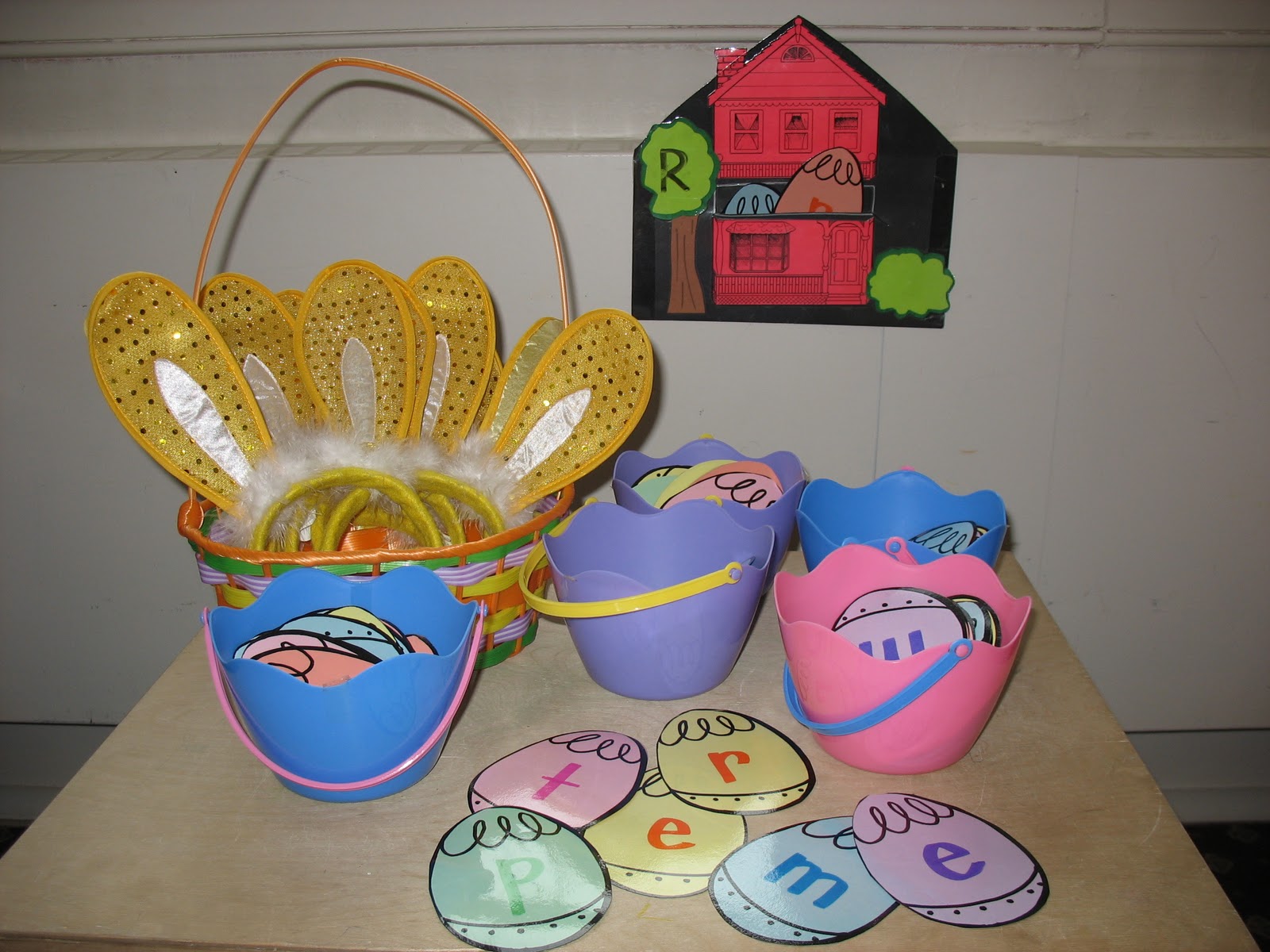
This Easter Egg Delivery Egg-stravaganza game is the perfect activity to play with a group of 4 or 5 students during your Center Time or at Literacy Stations. The curricular objective of the game is for students to match upper-case letters with their lower-case counterparts.
Before you begin, place a number of "houses" with upper-case letters around the classroom. Provide each student at the station with a basket full of paper Easter eggs with lower-case letters printed on them (these lower-case letters need to match the upper-case letters of your houses... or else there would be no matching and no point to the game). The children then hop about the classroom (a sneaky way to work on large-muscle development during language arts instruction) delivering eggs to their correct houses. I give each of my students a pair of floppy golden bunny ears to wear to really get everyone into the spirit. Once everyone has finished delivering their eggs, we take down each house and go through the contents to ensure that there were no delivery mistakes. At this point, to deepen the learning, we also talk about the corresponding sound each letter makes and I ask every student in the group to tell me a word that starts with the letter. They can look for clues using the colourful alphabet posters that decorate our classroom. This is definitely a much richer learning experience than an ABC worksheet.
Time Saving Tip: I write the upper-case letters on the laminated houses with washable marker. That way, I can customize the letters for the children in each group. As well, I adapt this game over the course of the year. In December, the children don Santa hats and deliver little paper holiday stockings to each house. By February the children are ready to deliver valentine hearts with lower-case letters emblazoned on them. By providing theme and variation the children think they are engaged in an all-new game while allowing them multiple attempts to practice and eventually master the skill of letter matching. The possibilities are endless...
This Easter Egg Delivery Egg-stravaganza game is the perfect activity to play with a group of 4 or 5 students during your Center Time or at Literacy Stations. The curricular objective of the game is for students to match upper-case letters with their lower-case counterparts.
Before you begin, place a number of "houses" with upper-case letters around the classroom. Provide each student at the station with a basket full of paper Easter eggs with lower-case letters printed on them (these lower-case letters need to match the upper-case letters of your houses... or else there would be no matching and no point to the game). The children then hop about the classroom (a sneaky way to work on large-muscle development during language arts instruction) delivering eggs to their correct houses. I give each of my students a pair of floppy golden bunny ears to wear to really get everyone into the spirit. Once everyone has finished delivering their eggs, we take down each house and go through the contents to ensure that there were no delivery mistakes. At this point, to deepen the learning, we also talk about the corresponding sound each letter makes and I ask every student in the group to tell me a word that starts with the letter. They can look for clues using the colourful alphabet posters that decorate our classroom. This is definitely a much richer learning experience than an ABC worksheet.
Time Saving Tip: I write the upper-case letters on the laminated houses with washable marker. That way, I can customize the letters for the children in each group. As well, I adapt this game over the course of the year. In December, the children don Santa hats and deliver little paper holiday stockings to each house. By February the children are ready to deliver valentine hearts with lower-case letters emblazoned on them. By providing theme and variation the children think they are engaged in an all-new game while allowing them multiple attempts to practice and eventually master the skill of letter matching. The possibilities are endless...
Wednesday, March 23, 2011
'Tis The Season
This is quite possibly my favourite time of the school year. I am always amazed at the progress that my young students have made at this point. Many of the children have more than doubled their knowledge regarding letter identification and number concepts since the last progress report!
Student-Led Conferences are the perfect way to showcase the outstanding growth to parents. Each child is scheduled to visit our classroom with their parents for a 30 minute block of time. In that 30 minutes, they will visit 5 stations designed to highlight the knowledge and skills that we have been building over the past seven months. Following are the five stations that the Busy Bees will guide their families through:
READING STATION: I supply a number of familiar books for the children to choose from. I want the reading task to be easy for the children allowing them to fluently read the text to their parents. The directions for each station include suggested questions that parents may ask their children to deepen the conference conversation.
SHOPPING SPREE STATION: The children play this math game to demonstrate their knowledge of numeral identification as well as their skill at counting objects (in this case pennies) using one-to-one correspondence. I supply enough pennies so that mom and dad can join in the game.
SCIENCE SORTING STATION: This task actually includes three major areas for the children to tackle. First off, they demonstrate their fine-motor control by cutting out the seasonal pictures (both straight and curved lines!!). Secondly, they have to decide which picture goes where. Finally, they have to do all of this in a very short 5 minute span testing their time management skills.
SPIN-A-WORD STATION: This station is simply a literacy game that we play throughout the year. It is an easy, fun, and interactive way to get children to read a list of high-frequency words that we have been learning in class. I encourage advanced players to think of a sentence that has their word in it. I've learned from experience to supply a couple of chairs for parents to sit on... most adults seem reluctant to sit "criss-cross-applesauce" on the carpet. Go figure!
ABC BINGO STATION: And finally, a station to showcase letter/sound knowledge. The parental questions supplied lead the children to use more information around the classroom including our alphabet letter posters and our Word Wall featuring high-frequency words and classmate's names. And like any good Bingo parlour, upon completion the children can see me to collect their prize for a job well done (usually a bottle of bubbles or container of playdough... no cash pay-outs here).
QUICK TIPS: I picked up the plastic direction holders when the Eaton's department store went out of business many years ago. You can find similar display items at office supply stores but they can be very costly.
I attach clusters of balloons to each station as a way of ensuring that families visit the correct areas in our classroom (not sneak off to the block center or dig around in the sand table). The balloons also make our classroom look festive for the evening.
Finally, prior to the event, I send home a couple of reminders about the format of the Student-Led Conference. I always mention that "because the children need the undivided attention of their parents, siblings are not invited to attend the activities".
Wednesday, March 9, 2011
Frightfully Fun!
Lady GaGa has a legion of fans she affectionately refers to as her Little Monsters. Not one to be left out on a trend, I have my own little monster. His name is Marty the Math Monster and he regularly visits my Kindergarten classroom to introduce new math concepts or present some sort of problem for my students to solve. The children always look forward to Marty's visits.
I discovered Marty in a fancy lady toy boutique on 124th Street. As soon as our eyes met I knew that this little monster would be a perfect vehicle to get my young mathematicians excited about numeracy learning. A colleague at another school has implemented a similar idea with a large Curious George stuffed animal. She places puzzles, number problems, and math games in George's backpack.
Throughout the school year, Marty teaches the children important math vocabulary. These key words are placed on a 'Marty's Math Words' poster that the students can refer to.
One question I am most often asked is "Where can I get my own monster puppet to use in my classroom?" The store I originally purchased Marty from is, unfortunately, long gone. However, on a lovely summer day in Banff, I happened upon a whole rack of monster puppets in the store 'Duck, Duck, Moose'. To my delight my eyes met up with a replica of Marty (probably his twin brother) and another puppet who followed me home and quickly became Marty's Mama Monster. A frightfully fun family reunion, indeed!
Throughout the school year, Marty teaches the children important math vocabulary. These key words are placed on a 'Marty's Math Words' poster that the students can refer to.
One question I am most often asked is "Where can I get my own monster puppet to use in my classroom?" The store I originally purchased Marty from is, unfortunately, long gone. However, on a lovely summer day in Banff, I happened upon a whole rack of monster puppets in the store 'Duck, Duck, Moose'. To my delight my eyes met up with a replica of Marty (probably his twin brother) and another puppet who followed me home and quickly became Marty's Mama Monster. A frightfully fun family reunion, indeed!
![]() |
Saturday, February 19, 2011
Let The Good Times Roll
I had the pleasure to present my "Making Math Magical" session to a packed room of teachers at the North Central Teacher's Convention last week. After the presentation many people asked for copies of my "Roll A Santa/Snowman/Rabbit/Pirate" dice games. I will figure out a way to get those out but for now here is a photo of the games. Feel free to trace or redraw for yourselves!
These simple games are excellent since they allow students to develop their subitzing skills in a fun and interactive way. I cut out the little pieces for the children to add to the central figure. If you don't have the time or energy at the end of a long day, consider having the children draw in the items after a successful roll.
Wednesday, February 16, 2011
Get The Message
Morning Message activities are a staple in many Kindergarten literacy programs. Each morning my students participate in the shared reading of the message on our interactive SMARTboard. Before we begin, I have a few students predict what the text may say by checking out clues they see. Clues may include the picture or known high-frequency words in the text. We then read the message together paying particular attention to matching our voices to the words being pointed at.
Four key components to the Morning Message I provide for my students are:
- "Popcorn Words" (words that keep popping up in reading and writing... otherwise known as high-frequency words) at the top of the message. These words are up there for my students to refer to as they circle words they know.
- A picture. After all, most children in Kindergarten are non-readers for much of the school year. Visual support in the form of an illustration is completely appropriate.
- A familiar structure with controlled vocabulary. Every one of my messages, from the first day of school to the last day of school, features the date, a greeting to either the Busy Bees or girls and boys, and identification of what day it is. The only sentence that really changes is the third one which is usually connected to something we are doing in class that day, the state of the weather, or some other exciting news (such as a countdown to a field trip or an announcement of someone's birthday).
- A mystery sound box. As we read the message the children predict what the missing word may be in the context of what would make sense. Each empty box is a phonemic sound. I limit these missing words to just one per message.
Once we've read the message a couple of times students are invited to come up and circle words and punctuation they know. Here is what our Morning Message looked like after our 30 minute shared reading session:
The product looks messy but the process helps my students to look more deeply at text and become stronger independent readers as they inch their way to Grade One.
Please check back for interesting details regarding the way I connect "Popcorn Words" to an interactive bingo game and some silly hats.
Monday, February 14, 2011
100th Day
Here is the monster we made for the 100th Day of School. Her name is Mona and she proudly sports 100 spots cut out by the nimble fingers of the students in my class. Can you find the 100th spot?
It may not be the world's best poem but it rhymes (sort of) and I made it up all myself.
The Busy Bees rotated through five special 100th Day stations with the most popular being the Cupcake Decorating Station. Here is the "recipe" that the children had to follow as they assembled their sugary concoctions. Please don't tell our school nurse.
It may not be the world's best poem but it rhymes (sort of) and I made it up all myself.
The Busy Bees rotated through five special 100th Day stations with the most popular being the Cupcake Decorating Station. Here is the "recipe" that the children had to follow as they assembled their sugary concoctions. Please don't tell our school nurse.
Subscribe to:
Posts (Atom)