Search This Blog

Showing posts with label active learning. Show all posts

Monday, October 17, 2011

Sorting It Out

In my Kindergarten classroom we are in the thick of learning how to sort items according to shape, colour, and size.  Here are a couple of ideas to make sorting tasks less of a task and more of an adventure!


Smartie Sorting
With Halloween just around the corner it's easy to get your hands on mini boxes of chocolate Smartie candies.  My intention for the Smartie Sorting activity is to have each student sort the candies into 3 colour groups and (with a glance) decide which group is biggest and which is smallest.  To prepare for the activity the night before, I open all of the boxes of Smarties and ensure that each little box has only 3 different colours of candies and that one colour group is obviously bigger and one is obviously smaller.  (This may appear to be a lot of work but the richness of the activity warrants a little extra prep time before things get rolling in class... and with a little glue at the top of each previously opened box, no one even realizes that the boxes have been 'tampered' with!).  
An anonymous no-faced student checks to see which
colour group is the largest.
Once the children have physically sorted their Smarties into three colour groups, each child draws a representation of their findings on a simple bar graph.  
Students are asked to take their boxes of Smarties home to show their parents what they did in math class that day (and eat the candies if they so wish).


An Exploding Button Machine!
What happens when the Button Machine in a fashion factory explodes and a zany (and extremely beautiful) fashion designer enlists the help of young children to sort and reorganize the mess?  This idea was expanded from the Maximizing Kindergarten Math teachers resource that I helped to develop.  And, as always, I found a way to take it a step further and add a little performance art as well!  Check out the video clip below:


A large cardboard box containing a number of plastic baggies filled with mixed up buttons is delivered to the classroom for the children to sort.  Sorting buttons presents many opportunities for little mathematicians to identify numerous ways to sort (colour, number of holes, shape, size, etc.) and it is quite surprising to see how serious they are in helping poor (but extremely beautiful) Donnatella with her most recent misadventure in the factory. 

Wednesday, April 6, 2011

Hop To It!

One of my goals as a teacher of young children is to continually find ways to actively engage my students in learning.  I have been quite successful at resisting the temptation of plying my little learners with worksheets and reproduced "busy work".   I want my Kindergarten students to get up and move while interacting with one another!  Worksheets just don't do that (plus most five-year olds are not at the stage where they can sit independently for lengths of time while focusing on tasks which require large amounts of fine-motor coordination).  


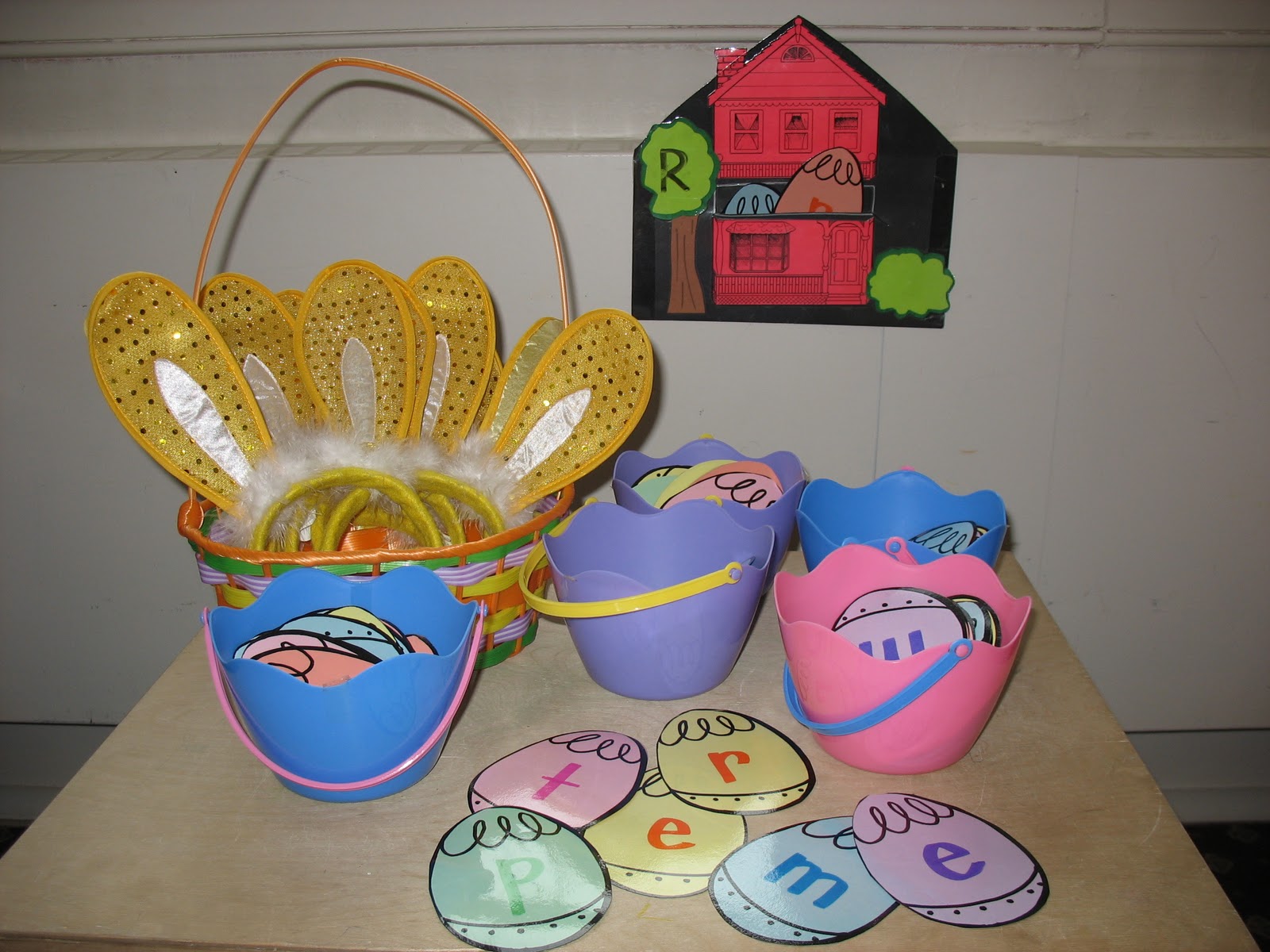
This Easter Egg Delivery Egg-stravaganza game is the perfect activity to play with a group of 4 or 5 students during your Center Time or at Literacy Stations.  The curricular objective of the game is for students to match upper-case letters with their lower-case counterparts.  


Before you begin, place a number of "houses" with upper-case letters around the classroom.  Provide each student at the station with a basket full of paper Easter eggs with lower-case letters printed on them (these lower-case letters need to match the upper-case letters of your houses... or else there would be no matching and no point to the game).  The children then hop about the classroom (a sneaky way to work on large-muscle development during language arts instruction) delivering eggs to their correct houses.  I give each of my students a pair of floppy golden bunny ears to wear to really get everyone into the spirit.  Once everyone has finished delivering their eggs, we take down each house and go through the contents to ensure that there were no delivery mistakes.  At this point, to deepen the learning, we also talk about the corresponding sound each letter makes and I ask every student in the group to tell me a word that starts with the letter.  They can look for clues using the colourful alphabet posters that decorate our classroom.  This is definitely a much richer learning experience than an ABC worksheet.


Time Saving Tip:  I write the upper-case letters on the laminated houses with washable marker.  That way, I can customize the letters for the children in each group.  As well, I adapt this game over the course of the year.  In December, the children don Santa hats and deliver little paper holiday stockings to each house.  By February the children are ready to deliver valentine hearts with lower-case letters emblazoned on them.  By providing theme and variation the children think they are engaged in an all-new game while allowing them multiple attempts to practice and eventually master the skill of letter matching.  The possibilities are endless...

Wednesday, February 16, 2011

Get The Message

Morning Message activities are a staple in many Kindergarten literacy programs.  Each morning my students participate in the shared reading of the message on our interactive SMARTboard.  Before we begin, I have a few students predict what the text may say by checking out clues they see.  Clues may include the picture or known high-frequency words in the text.  We then read the message together paying particular attention to matching our voices to the words being pointed at.
Four key components to the Morning Message I provide for my students are:
  • "Popcorn Words" (words that keep popping up in reading and writing... otherwise known as high-frequency words) at the top of the message.  These words are up there for my students to refer to as they circle words they know. 
  • A picture.  After all, most children in Kindergarten are non-readers for much of the school year.  Visual support in the form of an illustration is completely appropriate.
  • A familiar structure with controlled vocabulary.  Every one of my messages, from the first day of school to the last day of school, features the date, a greeting to either the Busy Bees or girls and boys, and identification of what day it is.  The only sentence that really changes is the third one which is usually connected to something we are doing in class that day, the state of the weather, or some other exciting news (such as a countdown to a field trip or an announcement of someone's birthday).
  • A mystery sound box.  As we read the message the children predict what the missing word may be in the context of what would make sense.  Each empty box is a phonemic sound.  I limit these missing words to just one per message.

Once we've read the message a couple of times students are invited to come up and circle words and punctuation they know.  Here is what our Morning Message looked like after our 30 minute shared reading session:
The product looks messy but the process helps my students to look more deeply at text and become stronger independent readers as they inch their way to Grade One.  

Please check back for interesting details regarding the way I connect "Popcorn Words" to an interactive bingo game and some silly hats.